Friday, December 02, 2005

EPIPHANY


MERRY CHRISTMAS ONE AND ALL

Sunday, October 23, 2005

THE HEADLESS HORSEMAN


The Headless Horsemanretold byS. E. Schlosser
One cold winter night, early in the New Year, a certain Dutchman left the tavern in Tarrytown and started walking to his home in the hollow nearby. His path led next to the old Sleepy Hollow cemetery where a headless Hessian soldier was buried. At midnight, the Dutchman came within site of the graveyard. The weather had warmed up during the week, and the snow was almost gone from the road. It was a dark night with no moon, and the only light came from his lantern.
The Dutchman was nervous about passing the graveyard, remembering the rumors of a galloping ghost that he had heard at the tavern. He stumbled along, humming to himself to keep up his courage. Suddenly, his eye was caught by a light rising from the ground in the cemetery. He stopped, his heart pounding in fear. Before his startled eyes, a white mist burst forth from an unmarked grave and formed into a large horse carrying a headless rider.
The Dutchman let out a terrible scream as the horse leapt toward him at a full gallop. He took to his heels, running as fast as he could, making for the bridge since he knew that ghosts and evil spirits did not care to cross running water. He stumbled suddenly and fell, rolling off the road into a melting patch of snow. The headless rider thundered past him, and the man got a second look at the headless ghost. It was wearing a Hessian commander's uniform.
The Dutchman waited a good hour after the ghost disappeared before crawling out of the bushes and making his way home. After fortifying himself with schnapps, the Dutchman told his wife about the ghost. By noon of the next day, the story was all over Tarrytown. The good Dutch folk were divided in their opinions. Some thought that the ghost must be roaming the roads at night in search of its head. Others claimed that the Hessian soldier rose from the grave to lead the Hessian soldiers in a charge up nearby Chatterton Hill, not knowing that the hill had already been taken by the British.

Tuesday, September 20, 2005

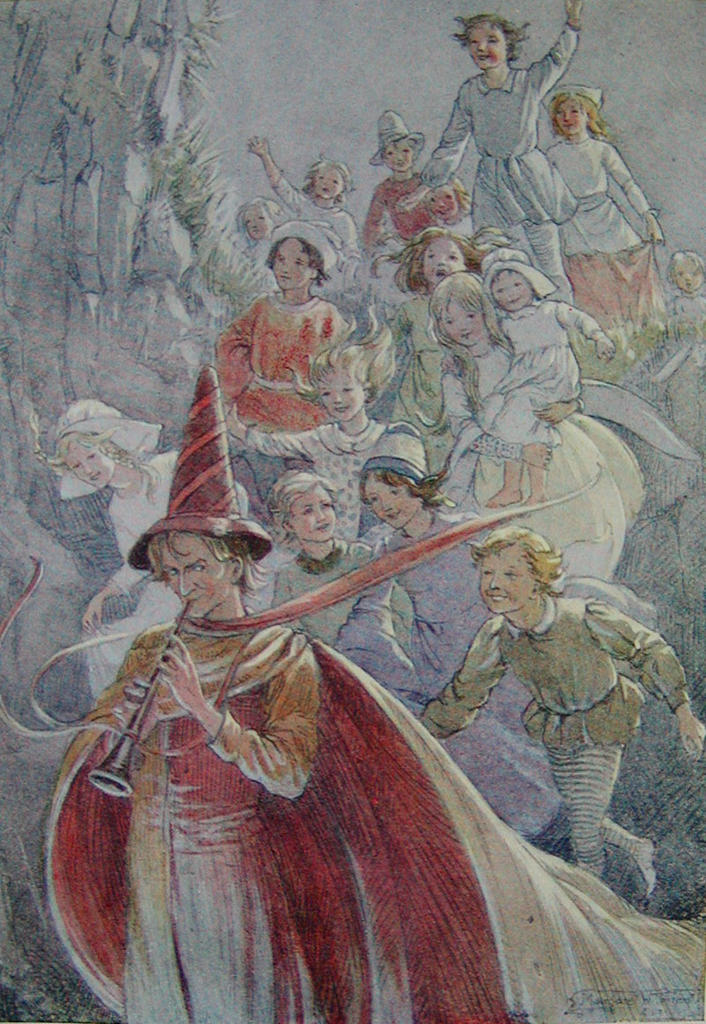
THE PIED PIPER OF HAMELIN


In 1284, the town of Hamelin is suffering from a terrible plague of rats. The town council tries everything to get rid of them -- without success. At last, the Mayor promises 1000 florins to the one who can put an end to the plague.
A stranger dressed in bright red and yellow clothes shows up and says he can rid Hamelin of the rats. At night, the stranger starts to play a soft tune on a flute, luring all the rats out of the houses and barns towards the river Weser, where they drown.
The Mayor refuses to pay the piper: "Playing a tune on a flute is not worth 1000 florins. Get out of Hamelin!"
But the piper returns on a Sunday morning, when all the grown-ups are at church. Again he starts to play a tune on his flute. This time, all the children follow him, as he walks out of the gate to the mountains. Suddenly, a cave opens in the mountain. The piper walks into the mountain, still followed by the children, and the cave closes again.
The children were never seen again in Hamelin.

Sunday, September 11, 2005

NILE QUEEN JAMARA (JAMIE)


CANTER CANTER LITTLE FILLY
CAREFREE AND OH SO SILLY
DANCE AND PRANCE ON TINY HOOVES
AND CATCH YOUR TAIL BEFORE IT MOVES


CANTER CANTER LITTLE FILLY
UP AND DOWN GREEN PASTURES HILLY
WONDROUS EYES SO DARK AND FREE
TO COMMAND ALL THAT YOU CAN SEE


CANTER CANTER LITTLE FILLY
WITH SILKEN EARS OF SCENTED LILLY
PROUD TAIL REACHING FOR THE SKY
WITH BEAUTY TO CAUSE THE GODS TO SIGH


TWINKLE TWINKLE LITTLE STAR
HOW I WONDER HOW YOU ARE
WAY UP IN THE SKY SO HIGH
I WONDER WHY YOU HAD TO DIE


CANTER CANTER LITTLE FILLY
ACROSS HEAVEN'S PASTURES HILLY
FREE FOR EVER IN THE SKY
UNDER THY ANGLE'S WATCHFUL EYE

From the ancient deserts of the Middle East evolved the oldest known breed of riding horse, the Arabian. Now one of the most popular breeds in America, the Arabians' incredible energy, intelligence and gentle disposition allow riders to excel in most equine sports and activities. Today, Arabian horses spend as much time on the trail as they do at horse shows and other competitive events.

Thursday, August 25, 2005

SKIPPY THE GAY KANGAROO

The reports of Skippy's death are premature. His mangled body was filled full of air and he is as good as new. Crash Test Wallaby can come home now. Skippy is OK and all is forgiven.

Tuesday, August 23, 2005

PUFF THE MAGIC DRAGON


Thank-you Peter Paul and Mary for your music.

Saturday, August 06, 2005

OUR NEIGHBORS THE ANIMALS


These animals are just a few of the many that we encounter.

From left to right: Coyote - Badger - Whitetail deer


OUR NEIGHBOR THE RACCOONS


Description - The raccoon is a reddish-brown above and black or greyish below. The most prominent characteristics are the bushy tail with 4-6 black or brown rings and the black mask outlined in white. The ears are small and the feet and forepaws are dexterous.
Distribution - This animal is native to the southern part of the Canadian provinces and most of the United States. It is most common along stream edges, open forests and coastal marshes.Biology - The raccoon inhabits hollow trees and logs for homes and often use the ground burrows of other animals for raising their young or for sleeping during the coldest part of the winter months. An average of 4-5 young are born in April-May; the mother at first carries them by the nape of the neck like a cat; they are weaned by late summer. Omnivorous, it feeds on grapes, nuts, grubs, crickets, small mammals, birds' eggs and nestlings. Often seen washing their food, the raccoon is actually feeling for matter that should be rejected as the wetting of the paws enhances its sense of feel. Winter is the raccoons greatest enemy when food is scarce.

Wednesday, July 20, 2005

CRASH TEST WALLABY


PLEASE DO NOT FEED YOUR FINGERS TO THE WALLABY

Saturday, July 16, 2005

JOHN F. KENNEDY TOOK US TO THE MOON


First, I believe that this nation should commit itself to achieving the goal, before this decade is out, of landing a man on the moon and returning him safely to the earth. No single space project in this period will be more impressive to mankind, or more important for the long-range exploration of space; and none will be so difficult or expensive to accomplish. We propose to accelerate the development of the appropriate lunar space craft. We propose to develop alternate liquid and solid fuel boosters, much larger than any now being developed, until certain which is superior. We propose additional funds for other engine development and for unmanned explorations--explorations which are particularly important for one purpose which this nation will never overlook: the survival of the man who first makes this daring flight. But in a very real sense, it will not be one man going to the moon--if we make this judgment affirmatively, it will be an entire nation. For all of us must work to put him there.

John F. Kennedy on May 25, 1961

In July 1969 the first man landed on the moon. Less then a decade after JFK made the above speech. Way to go John.

Sunday, July 10, 2005

NORTH AMERICAN OPOSSUM


An opossum mother may carry as many as thirteen babies in her pouch. Babies are most common between February and June.

Monday, July 04, 2005

GETTYSBURG ADDRESS (1863)


Four score and seven years ago our fathers brought forth on this continent, a new nation, conceived in Liberty, and dedicated to the proposition that all men are created equal.
Now we are engaged in a great civil war, testing whether that nation, or any nation so conceived and so dedicated, can long endure. We are met on a great battle-field of that war. We have come to dedicate a portion of that field, as a final resting place for those who here gave their lives that the nation might live. It is altogether fitting and proper that we should do this.
But, in a larger sense, we can not dedicate -- we can not consecrate -- we can not hallow -- this ground. The brave men, living and dead, who struggled here, have consecrated it, far above our poor power to add or detract. The world will little note, nor long remember what we say here, but it can never forget what they did here. It is for us the living, rather, to be dedicated here to the unfinished work which they who fought here have thus far so nobly advanced. It is rather for us to be here dedicated to the great task remaining before us -- that from these honored dead we take increased devotion to that cause for which they gave the last full measure of devotion -- that we here highly resolve that these dead shall not have died in vain -- that this nation, under God, shall have a new birth of freedom -- and that government of the people, by the people, for the people, shall not perish from the earth.

Source: Roy P. Basler, ed., The Collected Works of Abraham Lincoln, vol. 7 (1953-1955), 22.

Sunday, June 05, 2005

THE BARN SWALLOW


The popular and attractive Barn Swallow, found worldwide, is the most widespread of the swallows. In the western hemisphere, it winters in South America, but migrates northward to breed over most of North America. A round trip may cover 14,000 miles. They prefer open country, and readily nest on man-made structures. They perform an important economic function as they cruise low over lawns, fields, lakes, and ponds, consuming large numbers of flies, aphids, beetles, bees, moths, mayflies, dragonflies, grasshoppers, caterpillars and other insects.

The Barn Swallows (Hirundo Rustica) have taken over the barn again. They chase the barn cats out of the barn and land on my head once in a while to see who I am. They are busy rebuilding their nests from last year and will soon lay eggs. Flying lessons will begin in about 45 days when the young leave the nest. When not nesting they cruise the air catching flying insects on the fly.

JUNE MUST BE HERE